
A car that clicks but won't start most often has a weak battery, poor cable connection, failing starter circuit, or low system voltage. The click is a clue, but the number, speed, and location of the clicks help separate a simple battery problem from a larger electrical or mechanical issue.
No-start takeaway for drivers
- Rapid clicking usually points toward low voltage or a poor connection.
- One solid click can point toward a starter, solenoid, relay, or locked-up mechanical condition.
- Do not keep cranking repeatedly, because heat and low voltage can damage components and erase useful clues.
What the clicking sound is trying to tell you
When you turn the key or press the start button, the vehicle needs enough electrical power to close the starter circuit and spin the engine. A click can happen when a relay or starter solenoid tries to engage, but the system cannot complete the job. Sometimes the lights work and the radio turns on, yet the battery still cannot supply the high current needed for cranking.
That is why the symptom should not be judged by dashboard lights alone. Small accessories need far less current than the starter motor. A battery can look alive to the cabin electronics but still fail under load.
AAA's guide to common reasons a car won't start covers several causes beyond the battery, including key fob, gear selector, and neutral safety concerns. For a clicking no-start, though, the diagnostic path usually starts with battery condition and cable integrity.
Rapid clicking versus one heavy click
| Sound pattern | Common direction | What to check first |
|---|---|---|
| Fast repeated clicking | Battery is weak, discharged, or not delivering current through the cables. | Battery state of charge, terminals, ground cable, and jump-start response. |
| One loud click | Starter solenoid engages but the starter may not spin, or the engine may not turn. | Starter circuit voltage, starter motor, engine ground, and mechanical lock concerns. |
| No click at all | Start request may not reach the starter circuit. | Key fob, brake switch, clutch switch, neutral safety switch, starter relay, immobilizer, and fuses. |
| Click plus dimming lights | High current draw or weak supply. | Battery load test, cable voltage drop, and starter current draw. |
| Click after recent service | Connection, ground, or battery disturbance may be involved. | Recent repair areas, loose terminals, and stored warning-light data. |
Start with the safest quick checks
First, make sure the vehicle is in Park or Neutral, the parking brake is set, and accessories are off. If the car uses a push-button start, check the owner's manual for the backup method when the key fob battery is weak. Many vehicles have a specific location where the fob must be held when its internal battery is low.
Next, look at the battery terminals without touching metal tools across both posts. Corrosion, looseness, or a visibly damaged cable can prevent current flow. A cable can look attached and still fail under load if the clamp is loose or the ground path is poor.
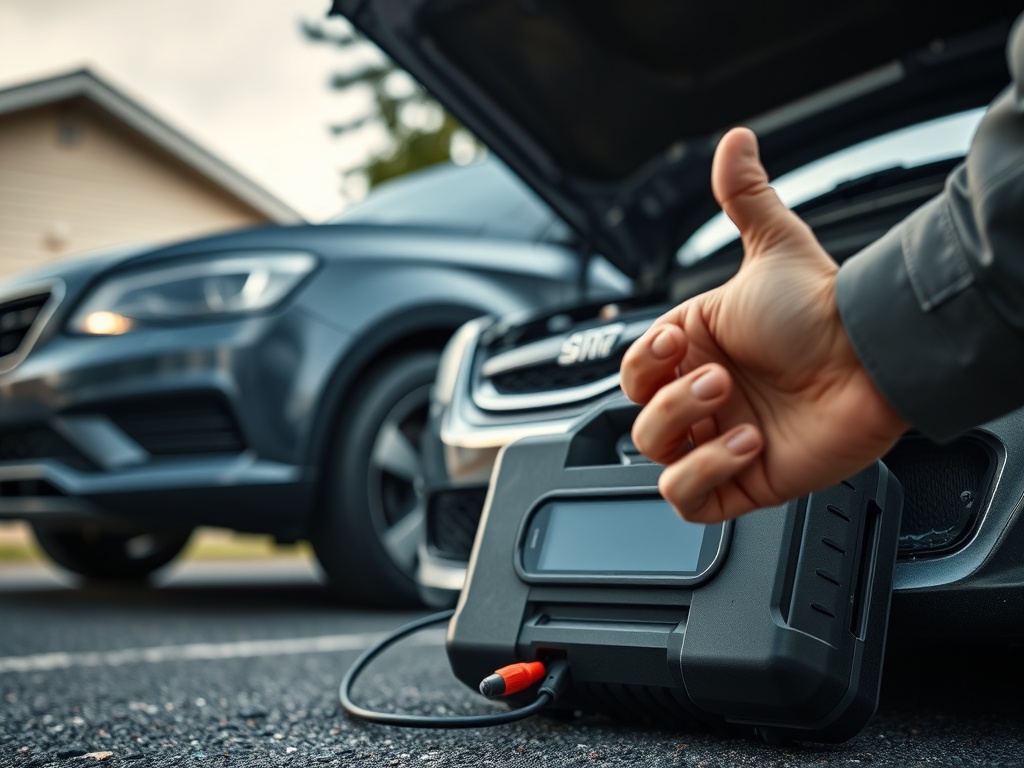
If a safe jump-start is attempted, follow the vehicle manual and the jump pack instructions. Some modern vehicles have remote jump posts rather than direct battery access. Incorrect boosting can damage electronics, so do not improvise if the manual gives a specific procedure.
Why a battery test beats a guess
A proper battery test checks more than voltage at rest. It evaluates whether the battery can hold voltage under load. A shop may also check the charging system, starter draw, and voltage drop across the cables. These tests help separate a weak battery from a starter that is drawing too much current or a cable that is losing voltage.
This matters because replacing the battery may not fix the root cause if the alternator is not recharging it, a parasitic draw is draining it overnight, or the starter is failing. Repeated no-start events can also create intermittent warning lights because low voltage can confuse modules and store communication faults.
When the starter circuit is the suspect
The starter circuit includes the battery, cables, grounds, relay, solenoid, starter motor, control module inputs, and safety switches. A one-click no-start can happen when the solenoid moves but the motor does not turn. A technician may test command signal, power supply, ground quality, and starter current draw before recommending a starter.
The starter is not always the villain. A poor engine ground can mimic starter failure. A seized accessory, locked engine, or mechanical issue can also prevent cranking. That is why a good diagnosis does not stop at the sound.
If the no-start follows overheating, coolant loss, or a suspected mechanical issue, do not keep cranking. Related cooling concerns can overlap with thermostat replacement myths because an overheated engine can create symptoms that look electrical at first.
The repair-shop conversation to have
Ask the shop what test separates the battery, cables, starter, and charging system. A reasonable answer might include a battery load test, charging-system output test, cable voltage-drop test, starter current draw, and scan for start authorization or immobilizer data. The shop does not need to perform every test for every car, but the recommendation should match the symptom.
The FTC's auto repair basics recommend asking about diagnostic charges and written estimates before authorizing work. That is useful for no-start diagnosis because the first test may reveal a simple connection issue, or it may lead to deeper electrical tracing.
- Ask for the battery test result, not just a statement that the battery is bad.
- Ask whether the charging system was checked after a battery replacement.
- Ask whether voltage drop was checked if cables or grounds look suspect.
- Ask whether the starter was tested under load before replacement.
- Ask whether stored codes were recorded before clearing them.
Do not overlook related safety symptoms
A clicking no-start can be part of a larger electrical pattern. Dim headlights, slow cranking, random module messages, blower motor changes, or steering assist warnings can point to voltage supply issues. Electric power steering systems, in particular, can be sensitive to voltage and communication problems, so a driver who notices heavy steering should review hydraulic and electric power steering symptoms before assuming the no-start is isolated.
If the vehicle starts after a jump, drive directly to a safe location or service facility rather than assuming the problem is solved. A weak battery, poor alternator output, or loose cable can strand you again.
Your fastest safe move
Record the sound pattern, note whether the lights dim, and avoid repeated cranking. If you can safely check that the terminals are tight and the vehicle is fully in Park or Neutral, do that first. After that, a battery and starting-system test is the cleanest path to a real answer.
A click is not a repair diagnosis by itself. Treat it as a clue, then ask for test results that prove the part before replacing it.